Southern Cameroons Defense Force Commander-in-Chief Ebenezer Akwanga (credit: Ebenezer Akwanga)
Ebenezer Akwanga, a scholar, peace advocate and former political prisoner, now leads a revolutionary militia for the newly declared independent country of Ambazonia in the former British Southern Cameroons of West Africa. Akwanga has strong views about a predatory international community that has long raided Africa for its people and riches.
Akwanga holds a Doctor of Philosophy degree in Conflict Transformation and Peace Studies from South Africa’s University of KwaZulu-Natalin. The scholar suffered torture and seven years imprisonment, including two years in solitary confinement from a twenty-year jail term, which gave focus to his viewpoint. Akwanga escaped a Cameroon prison in 2003 to Nigeria where he lived for several years before taking up exile in the United States.
During an interview on the Ambazonian declaration of independence from Cameroon, a question about support from the international community provoked a short essay. Akwanga was blunt:
“Who is the international community? The United States, the United Kingdom, France, and Russia, who have divided the world into ‘special spheres of influence’ and ‘our backyard’ domination as in Crimea and Venezuela?”
“Or China’s overwhelming infiltration and strings on Africa’s domestic and economic survival at the detriment of respect for human rights and democratic principles?”
“Or is the international community the African Union, the spoiled-successor organization of the Organization of African Unity which has reduced itself to a ‘fraternity for criminals, political hoodlums, charlatans, misfits, tyrants and failed fathers and mothers’ who have for decades reduced Africa to beggary while there is plenty; imprisoned, tortured, exiled or murdered its manpower?”
“Or is the international community the countries in Scandinavia, who constantly open their doors to ‘brown-skin’ refugees while undermining the legitimate refugee claims of Africans South of the Sahara; Nordic countries that would extol human rights while unable to break diplomatic relations with monstrous, xenophobic annexationists’ regimes like the one in Yaounde?”
“Or is the international community a European Union which is unable to control the thieving excesses of Moliere’s France in Africa, a country that shamelessly continues to promote the economic, political and cultural enslavement of its former colonies in Africa?”
“Or is the international community a United Nations which is only seen to be ‘united’ every September and October of each year when it meets in New York to espouse a series of loud-sounding, meaningless speeches with national interest rather than the collective safeguard and positive development of mankind?”
“I am tired and sick of an international community in which internationalization is based on ‘greed’ and ‘national or regional preservation’ than a genuine concern for their fellow man. I am tired, sick and even vexed with an international community which is cowardly in their modus operandi and stupefying in their explanation, especially on something as delicate as the very survival of my people. There is no international community. There is national-international interest.”
Taiwan Civil Government members parade in Taichung on anniversary of 228 Massacre (credit: Taiwan Civil Government)
Once a year on February 28th, the anniversary of the 228 Massacre, the fog of strategic ambiguity lifts briefly in Taiwan and there is public acknowledgment that the exiled Republic of China government ruling Taiwan committed terrible crimes against the local people. While the ROC tries to downplay the tragedy by calling the bloodshed the 228 Incident, there is recognition that something wrong happened in 1947 when tens of thousands Formosans were murdered and tortured.
Taiwan Civil Government, an advocacy group, marked the solemn anniversary with a march in downtown Taichung. The marchers added a white headband to their customary black suit uniforms and kept a tight, military-like formation. TCG, formed in 2008, seeks to oust the Republic of China from the island with United States assistance.
There is no accurate count of the 228 Massacre dead, as bodies littered the streets and rivers after Chinese troops brutally suppressed a spontaneous uprising, but common estimates start at 30,000 deaths. The United States imposed ROC soldiers on Formosa, as Taiwan was then known, after the end of World War II to process surrendering Japanese soldiers. The Chinese civil war between the Communists and the Kuomintang grew into a larger Cold War after Chiang Kai-shek’s defeat in 1949.
It had been the stated intent of the United States to give Formosa to the ROC as war booty surrendered by the Japanese. However, the 228 Massacre crimes and subsequent White Terror period of harsh martial law kept the United States from its pledge at the 1952 San Francisco Peace Treaty. Taiwan has been stuck in “political purgatory” as a federal court described it in Roger Lin v. United States, ever since.
Taiwan’s unresolved status for seven decades has left everyone confused about the island’s sovereignty. TCG’s route to independence as a sovereign nation is by way of an interim United States military government. To achieve that goal TCG, which is noisily pro-American, has been courting the Donald Trump administration and spending heavily on Washington public relations campaigns.
Julian Lin, wife of TCG founder Roger Lin, scored a private session with presidential counselor Kellyanne Conway in May 2017. A visit by a TCG delegation with Members of Congress was to be capped with a meeting with Secretary of Commerce Wilbur Ross at the Heritage Foundation. However, a reception with Ross was canceled after Roger and Julian Lin and others were arrested for fraud in May 2018.
ROC prosecutors claim to be only protecting the interests of disgruntled TCG members who say they were deceived about the benefits of their identification cards. The Lins and others have denied guilt and assert the prosecution was intended to stop TCG progress in Washington. A non-jury trial is pending.
TCG has continued to organize and seek new members. The fraud arrests may have stopped business as usual but have shown significant resources within the group. The Taichung parade demonstrates that the beleaguered group has not given up its efforts to combat the ROC government imposed on the island so many years ago.
Black Panther Fred Hampton’s bullet riddled gravestone (credit: Facebook screenshot)
Fred Hampton, head of the Chicago Black Panther Party, and Mark Clark, of the Peoria chapter, were shot to death in a December 1969 bloody, pre-dawn police raid on Hampton’s apartment. Hunted by police in the deadly raid, Hampton remains a target for those opposed to his Black Panther advocacy. Hampton’s tombstone is bullet riddled by unknown vandals.
Hampton had been targeted for elimination under a clandestine counterintelligence program called COINTELPRO of the Federal Bureau of Investigation. In Chicago, FBI agent Roy Mitchell falsely informed State’s Attorney Edward Hanrahan’s special police unit that weapons had been moved into Hampton’s apartment.
On December 4, 1969, in a FBI orchestrated raid by Hanrahan’s special squad, Hampton and Clark were shot to death. Fourteen handpicked policemen, armed with twenty-seven firearms including a Thompson submachine and shotguns, converged on Hampton’s apartment at 4:45 a.m. The police fired a barrage into the quiet apartment killing the two Panther leaders and wounding all of the other occupants.
Attorney Paul Wolf has commented on a nearly identical raid in Los Angeles. “Four days after a similar raid on a Panther apartment in Chicago, forty men of the Special Weapons and Tactics squad, with more than a hundred regular police as backup, raided the Los Angeles Panther headquarters at 5:30 in the morning.”
“The similarities between the Chicago and Los Angeles raids are undeniable, with a special local police unit closely linked to the FBI involved in both assaults, spurious warrants seeking “illegal weapons” utilized on both occasions, predawn timing of both raids to catch the Panthers asleep and a reliance on overwhelming police firepower to the exclusion of all other methods. Both raids occurred in the context of an ongoing and highly energetic anti-BPP COINTELPRO, and—as in the Hampton assassination—bullets were fired directly into Pratt’s bed. Unlike the Chicago leader, however, Pratt was sleeping on the floor, the result of spinal injuries sustained in Vietnam.”
In May 1973, a report from an independent Commission of Inquiry into the fatal shooting of Fred Hampton was issued. Chaired by Roy Wilkins and Ramsey Clark, the Commission was sharply critical of law enforcement officials.
“The fact that neither the state’s attorney nor the police have been indicted for their roles in the planning and execution of the raid…raises disturbing questions about the degree to which improper police or prosecutorial conduct is presently subject to any orderly system of correction and control.”
“It is very difficult legally to justify the vast amount of shooting throughout the apartment by police when only one shot can be ascribed with confidence to any occupant.”
“The police who removed the bodies received their instructions from the State’s Attorney’s Office….By moving the bodies in the apartment from the locations in which they died, and then removing them from the premises entirely, the police on the scene severely hampered the coroner’s ability to perform his duty of determining the immediate and underlying cause of death. The inference is compelling that the State’s Attorney’s Office simply did not want a contemporaneous on-the-scene investigation by the Coroner’s Office.”
The role of the FBI in the deadly raid was not then known. Documents later released under Freedom of Information Act litigation revealed agent Mitchell gave the police a diagram of Hampton’s apartment and that Hampton’s bodyguard, William O’Neal, was a paid FBI informant. O’Neal has been suspected of drugging Hampton at supper before the raid to immobilize him.
Over the years there has been growing recognition of the potential that Fred Hampton had to offer the public. A charismatic leader, Hampton had the ability to reach out to others. Sadly, a walk in the cemetery where Hampton is buried reveals that the racism that he opposed is still alive and virulent.
Eyewitness cell-phone image of burning Kumba hospital (credit: SCSTCC)
The Southern Cameroons Special Tribunal Coordinating Committee, a citizen-based human rights investigation team representing a consortium of Ambazonian separatist groups, is investigating attacks on hospitals by the Cameroon military. News reports cite numerous attacks on medical facilities and ambulances in the government’s effort to deny medical care to wounded Amba rebels. Recent hospital attacks in the civil war-torn region are blamed by eyewitnesses on soldiers while Cameroon officials blame the rebels.
The Special Tribunal, which utilizes citizen volunteers to capture photographic evidence of war crimes, provided the first reports on the burning of Kumba hospital, backed up by a cell-phone video of the burning building. Eyewitnesses reported that approximately 30 soldiers entered at night on Feb. 11 and set the hospital on fire. Four people, including two patients, were killed in the blaze.
Cameroon Communication Minister René Emmanuel Sadi denied the allegation, blaming the attack on pro-independence rebels. However, the Interim Government, an outlawed group leading a revolt in Ambazonia, has insisted that government soldiers committed the act. Government troops have also been blamed for the arson of the hospital in Konye.
Special Tribunal Coordinator Jonathan Levy has noted eyewitnesses blame 20 Cameroon soldiers for shooting up the Baptist Medical Center in Bangolan on Feb. 13. Days later at Shisong General Hospital soldiers stormed the medical center and threatened doctors and nurses. There was a tense hour at the hospital while the soldiers debated burning the facility.
Limited access to war-torn areas by the news media has kept many atrocities from being reported in the restive Southwest and Northwest regions of Cameroon. Despot Paul Biya has responded to the revolt against his authoritarian rule by turning his soldiers loose on hunt and kill missions. The difficulty of documenting the military actions in remote regions and often at night has led the Special Tribunal to call for volunteers to furnish self-collected evidence of war crimes. The plea for help is not without danger for those caught with cell-phones while recording events.
The burning of Kumba hospital is an example of how technology and the prevelance of cell-phones makes it possible for ordinary people to document crimes done by Cameroon soldiers. It remains to be seen if the Special Tribunal will be able to see charges brought against war crimes suspects with the evidence it is gathering. Operating without a legal mandate, the Special Tribunal is a new response to an age-old problem of obtaining justice for victims of war crimes.
Biya’s harsh response with bloodshed and violence to the declaration of Ambazonia in 2017 has deepened division in Cameroon as civil society unravels. Without a strong international response against abuses by Cameroon military forces the Special Tribunal may have more work than it can handle.
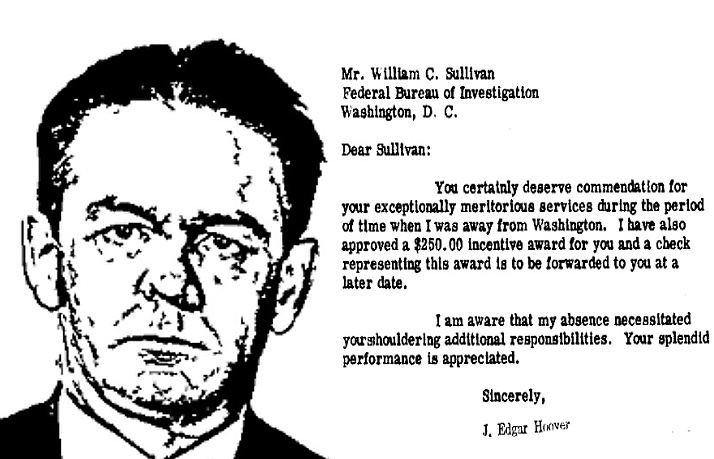
Assistant FBI Director William Sullivan was in charge of COINTELPRO operations (credit: Federal Bureau of Investigation)
The August 17, 1970 bombing murder of Patrolman Larry Minard prompted a request from Special Agent in Charge Paul Young of the Federal Bureau of Investigation office in Omaha for assistance in the case. Young’s request was unusual in that no written report was to by made the FBI Laboratory to help solve the crime.
A secret memorandum to lab chief Ivan Willard Conrad outlined a covert plan to withhold a report on the identity of the unknown 911 caller who lured police into a deadly trap. Operating under directives from FBI Director J. Edgar Hoover under the clandestine COINTELPRO program, Young moved quickly to place the blame for the bombing on leaders Edward Poindexter and David Rice of Omaha’s affiliate chapter of the Black Panther Party called the National Committee to Combat Fascism.
Assistant to Hoover and third in command of the Bureau,William Sullivan was on the memorandum distribution list and initialed the document indicating his approval of the conspiracy to withhold a lab report on the 911 caller’s identity.
Three days later back from vacation, Hoover gave Sullivan an unexpected $250 “incentive award” for the time Hoover was gone. Sullivan’s duties included going along with the plan to withhold a FBI Laboratory report on the identity of a policeman’s killer.
Hoover wrote, “You certainly deserve commendation for your exceptionally meritorious services during the period of time when I was away from Washington.”
“I am aware that my absence necessitated your shouldering additional responsibilities. Your splendid performance is appreciated.”
A second memorandum to Ivan Conrad at the FBI Laboratory about the Minard murder reviewed developments in the crime investigation and reaffirmed the earlier request to not issue a laboratory report. William Sullivan’s initials are beside his name indicating his approval. The war on the Black Panthers was a priority for Sullivan and he stayed informed, following counterintelligence actions and developments closely.
In October 1970, Sullivan spoke to a convention of United Press International editors and reporters in Williamsburg, Virginia. When asked about communist responsibility for racial unrest Sullivan admitted that no evidence existed of communist instigation of any of the riots that erupted in cities around the nation over the summer and instead blamed extremists.
“The vanguard of black extremism today is the Black Panther Party with its demonstrated proclivity for violence. The party was founded in 1966 ostensibly as a self-defense group against police officers. It has, however, been constantly on the offensive in keeping with its battle cry of “off the pigs”—Panther jargon for “kill the police”. According to Panther thinking, the police are the first target in the program for “liberation” of the black community and the violent destruction of white America.”
The speech would prove to be the last of Sullivan’s FBI career. Hoover was furious with Sullivan and said the speech threatened the Bureau’s budget by elimination of the communist threat.
Sullivan’s speech included a denial of counterintelligence actions against the Black Panthers and the only public FBI mention of the bombing in Omaha. Sullivan didn’t have all of his facts correct, he was wrong on the date and number arrested.
“On August 12, 1970, an Omaha, Nebraska, police officer was literally blasted to death by an explosive device planted in a suitcase in an abandoned residence. The officer had been summoned by an anonymous telephone complaint that a woman was being beaten there. An individual with Panther associations had been charged with this crime.”
Anti-war protests filled Washington in May 1971 with demonstrators. Sullivan and an unidentified “Security Coordinating Supervisor” took to the streets to see what was going on. The supervisor later prepared an affidavit on Sullivan’s tour.
“One of the areas we visited was Dupont Circle….I observed a young male demonstrator on the sidewalk to the right of the car and standing about 15 feet from the car. He jeered at us and made noises which gave me the impression he felt we were police officers. I raised my camera in an attempt to secure a photograph of the man through the windshield of the car, during which time he continued to jeer and moved toward our vehicle. Mr. Sullivan removed a canister of mace from his pocket, rolled the window down and sprayed mace at the man who was then about 6 feet from the car. I did not secure a photograph; the signal light changed and we immediately drove out of the area.”
The next day Sullivan got another taste of action when he was surrounded by protesters outside the Justice Department building as he surveyed the scene of an angry protest. FBI agents arrested a man for writing on the walls of the building with red paint. As demonstrators moved toward the arrest, Sullivan found himself alone in a hostile crowd. An agent later provided a first-hand report. “The crowd surged forward and someone yelled that Assistant Director Sullivan was still out there. I saw Sullivan standing alone about four feet from the gate. The crowd was yelling at him and the obscenities continued. Suddenly his foot flew out as if to kick at a demonstrator.”
“I did not see him make contact with his foot. Then to defend himself, I next saw Sullivan waving a blackjack in his right hand. He was still about four feet from the gate. The two agents rushed out and forced him back inside the entranceway. The crowd continued to throw objects and spit at all of us.”
Relations between Hoover and Sullivan further deteriorated. A visit to Hoover’s inner office turned into a two and a half hour shouting match. Hoover berated Sullivan for a litany of errors and faults. Sullivan told Hoover that he should retire.
Hoover then formally requested that Sullivan apply for retirement immediately and take accumulated leave. Sullivan had lost the struggle with Hoover for control of the FBI. “It has been apparent to me that your views concerning my administration and policies in the Bureau do not meet with your approval or satisfaction, and thus has brought about a situation which, though I regret, is intolerable for the best functioning of the Bureau.”
Hoover’s last encounter with Sullivan resulted in another hollering session. Hoover shouted at Sullivan. Sullivan shouted back. The heated exchange between the two men drove Hoover to write again to Sullivan about forced retirement. “I deeply regret the occasion to take action such as this after so many years of close association, but I believe it is necessary in the public interest. Your recently demonstrated and continuing unwillingness to reconcile yourself to, and officially accept, final administrative decision on problems concerning which you and other Bureau officials so often present me with a variety of conflicting views has resulted in an incompatibility so fundamental that it is detrimental to the harmonious and efficient performance of our public duties.”
Sullivan took to the road on a speaking tour about his days with the Bureau. Sullivan’s account of J. Edgar Hoover’s mental decline made the front-page of the Boston Globe in an article entitled “Ex-aide Bares Hoover’s Erratic Last Years.” Sullivan called Hoover “raving mad.” According to Sullivan, Hoover was “extremely erratic” and would go into rages filled with with wild talk. The unstable episodes increased in frequency during the three years before Hoover’s death in 1972.
A seemingly reformed Sullivan submitted written comments to the Roscoe Pound American Trial Lawyers Foundation proposing a three-year moratorium on government eavesdropping.
“The FBI as it is now structured is a potential threat to our civil liberties, recent events indicate this…..It would help greatly in removing the FBI from politics and politics from the FBI…This would be a tremendous accomplishment for the good of the country.”
“The weaknesses of the FBI have always been the leadership in Washington, of which I was a part for 15 years. I accept my share of blame for its serious shortcomings.”
Sullivan was being untruthful with the lawyers group. Sullivan accepted no blame for COINTELPRO crimes and did not reveal his control of illegal counterintelligence actions. Sullivan did not reveal he approved a conspiracy to let an Omaha policeman’s killer get away with murder.
On a chilly November day in 1977, Sullivan arose before dawn at his Sugar Hill, New Hampshire home and set out on an early-morning walk in the woods. Across a field, a young hunter, Robert Daniels, Jr., son of a state trooper, picked up movement in his rifle scope and fired.
William Sullivan died where he fell, in a pool of his own blood.FBI Disrector Clarence Kelley received a teletype message about Sullivan’s death from the Boston field office. FBI agents knew of the shooting for an hour and a half before the widow was told by a former special agent and the local police chief, a friend of Sullivan.
The House Assassinations Committee wasted no time in seeking the papers and files of Sullivan. Committee chief investigator, Clifford Fenton, Jr. showed up at Sullivan’s house with a subpoena for records. Sullivan’s widow had left for the funeral in Massachusetts and was not home. Sugar Hill Police Chief Gary Young denied Fenton access to the residence and publicly criticized the attempt to get information ending the Committee effort. Sullivan had been slated to testify to the Assassinations Committee.
Attorney William Kunstler charged that William Sullivan was murdered to keep him from talking about what he knew about the assassinations of Malcolm X and Martin Luther King, Jr.
“There isn’t the slightest doubt. I think Mr. Sullivan’s death will present a shocking picture of a cover-up greater in scope than Watergate.” Kunstler said that Sullivan was poised to “blow the whistle” on the slayings of the two black leaders.
Kunstler followed with a formal request to Attorney General Griffin Bell to investigate the death of Sullivan. “I call to your attention the fact that there was ample motive on the part of scores of individuals to desire Mr. Sullivan’s death. Among other things, it was Mr. Sullivan who apparently revealed the inner workings of COINTELPRO, the acronym for the FBI’s covert action program against domestic groups.”
“I call upon you, with all the force I can muster, to order at once the investigation sought by this communication. The recent history of this country has revealed that cover-ups of crime are not isolated or aberrational events.”
The Justice Department responded to Kunstler that there would be no investigation into the death of Sullivan. “The person responsible for the shooting has acknowledged it and the physical evidence substantiates his account.”
The two Black Panther leaders framed by Sullivan and others for the Omaha bombing, Poindexter and Rice (later Wopashitwe Mondo Eyen we Langa), were convicted in a controversial 1971 trial ten days before COINTELPRO was officially terminated. The jury never heard the killer’s voice on the recording that had been sent to the FBI Laboratory and no analysis of the 911 tape was made.
Mondo died at the maximum-security Nebraska State Penitentiary in March 2016. Poindexter remains imprisoned serving his life without parole sentence, forty eight years later, where he continues to proclaim his innocence.
Roger Lin and Washington attorney Charles Camp at Taiwan Civil Government headquarters (credit: Taiwan Civil Government)
Roger Lin, the founder of Taiwan Civil Government, an advocacy group, sought United States passports in 2006 for Taiwanese under the control of the Republic of China in-exile. Lin and others filed suit in the District of Columbia federal court seeking the passports under terms of the 1952 San Francisco Peace Treaty. Lin is now facing prosecution by the ROC for alleged political fraud, accused of deceiving TCG members with false claims about identification cards and vanity license plates. Lin will be tried in Taoyuan District court without benefit of a jury trial, leaving his fate in the hands of an ROC judge.
In the passport case, Lin appealed a denial by the District Court which ruled the case was a political issue not a legal matter. The appeal was decided in 2009, a year after Lin founded Taiwan Civil Government. Although Lin lost the case he found an interested court. The unresolved status of Taiwan since the end of World War II leaves the United States, under the San Francisco Peace Treaty, the chief occupying power. The ROC was not a party to the peace treaty.
Washington attorney Charles Camp was Lin’s lawyer and litigated the lawsuit. Camp continues to maintain the claim was meritorious. A three judge panel issued the Lin v. United States decision and opened the ruling with a strong declaration about Taiwan’s stateless condition in the first sentence. The friendliness of the court in Lin’s case suggests that he came close to obtaining the passports.
“America’s and China’s tumultuous relationship over the past sixty years has trapped the inhabitants of Taiwan in political purgatory. During this time the people on Taiwan have lived without any uniformly recognized government. In practical terms, they have uncertain status in the world community which infects the population’s day-to-day lives. This pervasive ambiguity has driven Appellants to try to concretely define their national identity and personal rights.”
“Determining Appellants’ nationality would require us to trespass into a controversial area of U.S. foreign policy in order to resolve a question the Executive Branch intentionally left unanswered for over sixty years: who exercises sovereignty over Taiwan. This we cannot do.”
“We do not disagree with Appellants’ assertion that we could resolve this case through treaty analysis…we merely decline to do so as this case presents a political question which strips us of jurisdiction.”
“Once the Executive determines Taiwan’s sovereign, we can decide Appellants’ resulting status….But for many years…the Executive has gone out of its way to avoid making that determination, creating an information deficit for determining the status of the people on Taiwan.”
“Appellants may even be correct; careful analysis of the SFPT might lead us to conclude the United States has temporary sovereignty. But we will never know, because the political question doctrine forbids us from commencing that analysis. We do not dictate to the Executive what governments serve as the supreme political authorities of foreign lands.”
With the election of Donald Trump, the strategy of TCG has been to get the White House involved in resolution of Taiwan’s status. Meanwhile, Trump is fighting a trade war with China while Taiwan is getting growing attention in Washington.
Roger Lin and his wife Julian now face long prison sentences from the exiled government they seek to expel from Taiwan. The fraud arrests have cooled Washington progress for TCG despite an increase in spending on publicity by the group. News reports on the fraud prosecution are non-existent in the United States as the fog of ambiguity clouds this unique, international crime story.
Northwest Province Governor Adolphe Lele Lafrique of Cameroon named as war criminal by Special Tribunal (credit: CRTV screenshot)
The Southern Cameroons Special Tribunal Coordination Committee has announced its first accusation. Adolphe Lele Lafrique, governor of the Northwest Province of the Republic of Cameroon, has been accused of war crimes. Lafrique is the ultimate civil authority in the Northwest Province, which along with the Southwest Province composes the self-declared Republic of Ambazonia.
The Special Tribunal has received a mandate from a half-dozen Ambazonian groups and their supporters to collect evidence, carry out investigations, and prosecute using any and all means possible, including the national courts of third countries and international tribunals. Remedies the Special Tribunal will seek include visa bans, asset forfeitures and sanctions on implicated individuals and organizations.
The initial backers of the Special Tribunal include the Southern Cameroons National Council, the Southern Cameroons Defense Force, the Ambazonia Governing Council, the African Peoples Liberation Movement, the Organization of Emerging African States, and the Cameroon Anglophone Civil Society Consortium.
Last year, Lafrique announced a plan to crush the Ambazonian uprising without mercy and deployed units of the elite Battalion D’intervention Rapide to militarily engage and eliminate Ambazonian secessionists. BIR has been equipped and trained in part by the United States Africa Command, dubbed AFRICOM, to fight Boko Haram terrorists. The United States has announced the suspension of military aid to the troubled African nation because of human rights violations by the government of despot Paul Biya. Special Tribunal Coordinator Jonathan Levy called the suspension of arms “progress” in bringing peace to the civil war-torn region.
Amnesty International has documented numerous BIR violations of human rights, including summary execution, brutality and torture by BIR units. The Special Tribunal is in the process of gathering and investigating additional information about BIR including destruction of villages, crimes against women and children, and looting.
Levy released a statement that explained the calling in of BIR troops, trained and equipped to fight terrorists, exposed civilian noncombatants to harm. BIR had already acquired a reputation for brutality in the Boko Haram campaign. “By calling for BIR to crush the secessionists, Lafrique in no uncertain terms consigned civilians to death and created tens of thousands of internally displaced persons.”
The announcement of the formal accusation against Lafrique was prompted by recent reports of brutality against civilians by government forces in the Kumba town region of the Northwest Province. Investigation and evidence-gathering is ongoing against Lafrique and many others. The Special Tribunal is disseminating the Lafrique dossier to accredited national and international war crimes units, international government organizations, and will be seeking criminal charges in third countries against the governor.
Shelley Hymes and Neil Hare are paid mouthpieces for Taiwan Civil Government (credit: Taiwan Civil Government)
The May 2018 arrests of Roger and Julian Lin and others in Taiwan for political fraud were followed by heavy spending in Washington by Taiwan Civil Government, an advocacy group, Roger Lin, TCG founder, seeks United States assistance expelling the exiled Republic of China from Taiwan. TCG has sunk a lot of money on publicity agents in Washington since Lin’s arrest.
Accused of making false claims about the benefits of a TCG identification card and vanity license plates, the Lins face long prison sentences. The expenditures in Washington for publicity may be driven by a virtual news whiteout about the case, a unique international crime story with political overtones.
TCG is one of many groups and parties seeking to remove the ROC from Taiwan. The unsettled sovereignty status of the island for seven decades has spawned a rainbow spectrum of approaches to Taiwan independence. TCG was formed in 2008 and has advanced its pro-American message with heavy spending for publicity and praise of President Donald Trump.
A week after the midnight raids and arrests, TCG paid Global Vision Communications a hefty $165,375.81 for a “Professional Management Fee.” Neil Hare, President of GVC and registered Foreign Agent for TCG, was given another management fee of $109,384 a month after the arrests. This was followed in mid-June with $93,313.33 for “Strategic Consulting Services.” TCG gave Hare’s company a total of $368,073.24 in professional fees in a five week period after the arrests.
In a required report to the Department of Justice under the Foreign Agent Registration Act the group also disclosed spending $232,047.94 on “Advertising, Shipping, and Event Expenses” following the arrests in Taiwan.
Shelley Hymes, owner of Angel Enterprises, a Washington public relations firm, may be TCG’s angel in Washington but she comes with a big price tag. Hymes had received a payment of $102,183.33 on May 1, 2018 for work she had done planning a TCG session with Commerce Secretary Wilbur Ross at the Heritage Foundation.
After the arrests in Taiwan the money started flowing. Angel Enterprises got $15,560.56 on June 12, $45,000 on June 22, $45,000 on June 27,000, $29,908.32 on July 16, and $25,000 in September. Hymes pulls double duty for TCG, also serving on the board of the newly formed Taiwanese American Chamber of Commerce funded by the advocacy group.
Neil Hare is the man of the hour serving as registered Foreign Agent, chief lobbyist and publicist, official spokesman, and head of TCG’s Chamber of Commerce chapter. Hare doesn’t come cheap either, pulling in over a million dollars from TCG in the last two years. Some TCG members are beginning to wonder if the money was well spent while others praise Hare and Hymes. Perhaps the answer will be found out in a Taoyuan District courtroom when the fate of Roger and Julian Lin is determined.
Assistant FBI Director John Mohr was in charge of the Administrative Division when he conspired to fix a murder investigation in Omaha. (credit: Federal Bureau of Investigation)
John Mohr was in charge of the Administrative Division of the Federal Bureau of Investigation when he received a $250 cash bonus from Director J. Edgar Hoover. While Hoover was on vacation, Mohr conspired with the head of the FBI Laboratory, Ivan Willard Conrad, Assistant Director Charles Brennan, and the Special Agent in Charge in Omaha, Paul Young, to withhold a lab report on the identity of a policeman’s killer. The misdeed was followed by the cash award immediately upon Hoover’s return.
Mohr oversaw communications between the field offices and the FBI Laboratory. Under the clandestine COINTELPRO counterintelligence program, Hoover had ordered Young in December 1969 to use an “imaginative” approach to remove Edward Poindexter and David Rice, later Wopashitwe Mondo Eyen we Langa, from Omaha’s streets. The two men were leaders of the local Black Panther Party affiliate chapter called the National Committee to Combat Fascism. Hoover had declared the Black Panthers as the number one threat to domestic security.
The August 17, 1970 bombing murder of Patrolman Larry Minard, Sr. gave Young the opportunity he needed to satisfy Hoover’s demands. Poindexter and Rice would be blamed for the bombing where police were lured to a vacant house by an anonymous 911 caller. At headquarters, William Bradley, a supervisor under Mohr, sent a memorandum to Conrad at the FBI Laboratory.
“Omaha Office has advised that the Omaha Police Department has requested laboratory assistance in connection with a bombing which took place in Omaha 8/17/70. This bombing resulted in the death of one police officer and the injuring of six other officers and is apparently directly connected with a series of racial bombings which the Omaha Police have experienced. The Police were lured to the bomb site by a telephonic distress call from an unknown male.”
“If approved, the results of any examinations will be orally furnished the Police on an informal basis through the SAC, Omaha.”
Back from vacation, Hoover agreed with the conspiracy to withhold a laboratory report on Minard’s killer and quickly came up with a bonus. Hoover sent a personal letter to Mohr commending him and awarding $250 for the “superior manner in which you fulfilled your responsibilities.”
The day after Minard’s funeral, Mohr wrote to Hoover, “I was deeply pleased that I was associated with a winning team at the Seat of Government while it was necessary for you to be on the Coast and I was delighted to learn that you thought our efforts were so satisfactory.”
Bradley sent a second memorandum to Conrad at the FBI Laboratory about the murder. “In referenced memorandum [8/19/70], the Director approved a request to assist the Omaha Police Department in captioned case through the use of voice comparison examinations by the Laboratory.”
“The SAC, Omaha, noted that he had been instructed by the Bureau to suggest steps of possible assistance to the Omaha Police in solving the bombings. He advised….the existing recording of the false “bait” complaint to the police is the most important present tangible evidence in the possession of the police, and he recommended the Bureau send a Laboratory representative.”
John Mohr’s name was on two distribution lists, a rubber-stamped distribution list and a special typed list with his initials at the bottom of the page. With the murder investigation compromised, the case was fixed The search for a killer was over. Poindexter and Rice were convicted of murder and received life without parole sentences. The jury that convicted them never heard the 911 recording that lured Minard to his death.
Several years later, while serving as executor for Clyde Tolson, his superior at the FBI, Mohr made himself and his daughter beneficiaries and left Tolson’s brother out of a will provided by Mohr. Tolson’s brother complained about Mohr in a contest over Tolson’s will. “The purported will and testament was procured…by fraud and deceit.”
A petition filed in the District of Columbia Superior Court by Hillory Tolson accused Mohr and unnamed others of “fraud, duress, coercion and undue influence” to extract a will before Clyde Tolson’s death that disinherited his brother. Mohr settled the matter out of court ending further allegations against him.
A Justice Department investigation triggered by charges made in 1975 to the House Intelligence Committee led to an investigation of Mohr by the Justice Department after his retirement. Although a five-year statute of limitations barred prosecution, Mohr was deemed guilty in a Special Report of violating federal laws for accepting gifts from a Bureau vendor and converting government property to his own use.
The Special Report also detailed the disgraced administrator’s misuse of FBI personnel. Mohr had his son’s sports car repaired and repainted by Bureau employees. Exhibit Section employees made Mohr an oak liquor cabinet, a walnut wine rack, a walnut cigar box, and two walnut gun cases. Mohr had his private automobile washed and worked on by Bureau employees and home electrical equipment and appliances were repaired. Mohr even had a custom birdhouse built for his backyard at taxpayer expense.
Although Mohr escaped punishment, the two Black Panther leaders targeted by Hoover did not. David Rice, renamed Wopashitwe Mondo Eyen we Langa, died in March 2016 at the Nebraska State Penitentiary serving his life without parole sentence. Edward Poindexter remains in maximum-security imprisonment, in poor health, where he continues to maintain his innocence as he has for forty-eight years.
FBI Laboratory Director Ivan Willard Conrad participated in COINTELPRO misdeeds (credit: Federal Bureau of Investigation)
The August 17, 1970 bomb murder of Omaha Patrolman Larry Minard was blamed on the Black Panthers. Two leaders of the National Committee to Combat Fascism, Edward Poindexter and David Rice (later Wopashitwe Mondo Eyen we Langa) were convicted at a controversial trial marred by withheld evidence. Targets of a clandestine counterintelligence program code-named COINTELPRO, the two men were marked by J. Edgar Hoover, the director of the Federal Bureau of Investigation, for elimination. The day of Minard’s death, Special Agent in Charge Paul Young put in motion an internal FBI conspiracy to blame the crime on the two Panther leaders.
At FBI headquarters, William Bradley, a supervisor in the Administrative Division, sent a memorandum to Ivan Willard Conrad, the director of the the FBI Laboratory. Young’s plan required the cooperation of the lab to withhold a report on the identity of an anonymous 911 caller that lured Minard to his death.
“Omaha Office has advised that the Omaha Police Department has requested laboratory assistance in connection with a bombing which took place in Omaha 8/17/70. This bombing resulted in the death of one police officer and the injuring of six other officers and is apparently directly connected with a series of racial bombings which the Omaha Police have experienced. The Police were lured to the bomb site by a telephonic distress call from an unknown male.”
“[Glen Gates] of the Omaha Police has requested [REDACTED]”
“The SAC, Omaha strongly recommends that the examination requested by the Omaha Police Department be conducted.”
“If approved, the results of any examinations will be orally furnished the Police on an informal basis through the SAC, Omaha.”
A handwritten, initialed notation by Conrad stated, “Dir advised telephonically & said OK to do.”
J. Edgar Hoover was still on vacation when Conrad called Hoover by phone for instructions. Hoover conducted limited FBI business while on vacation and was only called on important matters, however Conrad understood the significance of letting a policeman’s killer get away with murder necessitated making the call.
In Washington, William Bradley sent a second memorandum to Ivan Willard Conrad at the FBI Laboratory about the Minard murder. “In referenced memorandum [8/19/70], the Director approved a request to assist the Omaha Police Department in captioned case through the use of [voice comparison examinations by the Laboratory.]”
“By telephonic communication 8/21/70, the SAC, Omaha has requested that a Laboratory Supervisor travel to Omaha for the purpose of furnishing technical guidance to the Omaha Police concerning the correct techniques in obtaining known [voice samples for comparison purposes and make recommendations as to what commercially available equipment can be used in making known voice recordings.]”
“[No Bureau equipment will be used in connection with obtaining the known voice recording samples.]”
“The SAC, Omaha, noted that he had been instructed by the Bureau to suggest steps of possible assistance to the Omaha Police in solving the bombings. He advised technical guidance of the type requested would provide maximum immediate assistance, particularly since the [existing recording of the false “bait” complaint to the police is the most important present tangible evidence in the possession of the police], and he recommended the Bureau send a Laboratory representative.”
“RECOMMENDATION: That a Laboratory Supervisor travel to Omaha and furnish the Omaha Police with technical guidance in [obtaining known voice samples for comparison purposes.]”
At the end of August, J. Edgar Hoover sent the Los Angeles FBI office the altered diary of a Progressive Labor Party officer to use in falsely identifying the individual as a government informant. Hoover outlined the action with a memorandum. “Laboratory was requested to make forged entries in the diary. These entries were phone numbers at Army and Secret Service, which when called would identify the agency. Other notations in the diary indicate that [REDACTED] has been furnishing information to these agencies. He would thusly be branded as an informant….Documents Section of the Laboratory Division was authorized to make the necessary alterations to above diary, following which LA Office authorized to anonymously mail the altered diary to PLP headquarters in NYC.”
At the end of August, J. Edgar Hoover sent the Los Angeles FBI office the altered diary of a Progressive Labor Party officer to use in falsely identifying the individual as a government informant. Hoover outlined the action with a memorandum. “Laboratory was requested to make forged entries in the diary. These entries were phone numbers at Army and Secret Service, which when called would identify the agency. Other notations in the diary indicate that [REDACTED] has been furnishing information to these agencies. He would thusly be branded as an informant….Documents Section of the Laboratory Division was authorized to make the necessary alterations to above diary, following which LA Office authorized to anonymously mail the altered diary to PLP headquarters in NYC.”
Hoover’s use of the FBI Laboratory in COINTELPRO and other counterintelligence operations with falsified documents and fixed results compromised what was boasted to be the world’s best forensic laboratory. When Hoover told Ivan Conrad to withhold a report on the identity of the 911 caller in the Minard case or forge a diary entry against a Progressive Labor Party leader Hoover betrayed his own claims of objectivity and scientific integrity by the laboratory. The record of FBI Laboratory misdeeds spans decades and extended beyond the termination of the COINTELPRO program. Conrad cast a long shadow over the laboratory.
Conrad’s direction of the FBI Laboratory led to mediocre work, sloppy science, and false reports. The mismanagement of the laboratory and participation in COINTELPRO assignments did not become known to the public until after Conrad’s retirement departure.
False forensic testimony by Special Agent Thomas Curran in a 1974 murder trial and other complaints finally led to a review of the FBI Laboratory’s procedures. Although an investigation by Special Agent Jay Cochran was focused on the work of Curran, the picture of a substandard laboratory emerged.
In 1976, after Ivan Conrad’s retirement, the Washington Post reported on a Justice Department investigation of the Federal Bureau of Investigation. Conrad was found in possession of Bureau electronic equipment after a search of his McLean, Virginia home. The search yielded two station wagon loads of technical lab equipment.
Unnamed sources said that Conrad declared the equipment surplus so he could take it home where he reconditioned it before reselling the gadgets. Conrad was only a part of a “far-ranging probe of allegations of financial misconduct by FBI executives in the years preceding and immediately following Hoover’s death in May, 1972.”
The Justice Department investigation was triggered by charges made in 1975 to the House Intelligence Committee in a hearing about the U.S Recording Company and its large price mark-ups on FBI purchases. In 1978, the Department of Justice issued a formal report on the United States Recording Company scandal that included Conrad. According to the report, the retired FBI Laboratory director would not be prosecuted for taking $20,000 worth of equipment.
“Mr. Conrad took many pieces of electronic recording and amplifying equipment home with him and used them for his own benefit….The Department recovered all the equipment, and Mr. Conrad tendered a $1,500 cashier’s check to pay for his use of the equipment.”
“No further action has been taken against Mr. Conrad. Prosecution was barred, in the judgment of the Criminal Division, by the statute of limitations and because of the lack of evidence showing criminal intent on the part of Mr. Conrad.”
Wopashitwe Mondo Eyen we Langa died in March 2016 at the Nebraska State Penitentiary serving a life without parole sentence. Edward Poindexter remains imprisoned and continues to deny any role in the crime, forty-eight years behind bars.





 Richardson Reports